
This is the raw material behind Reality Space — the original audio recording of the conversation, the diagram I drew, and the unedited diarized transcript.
The Diagram
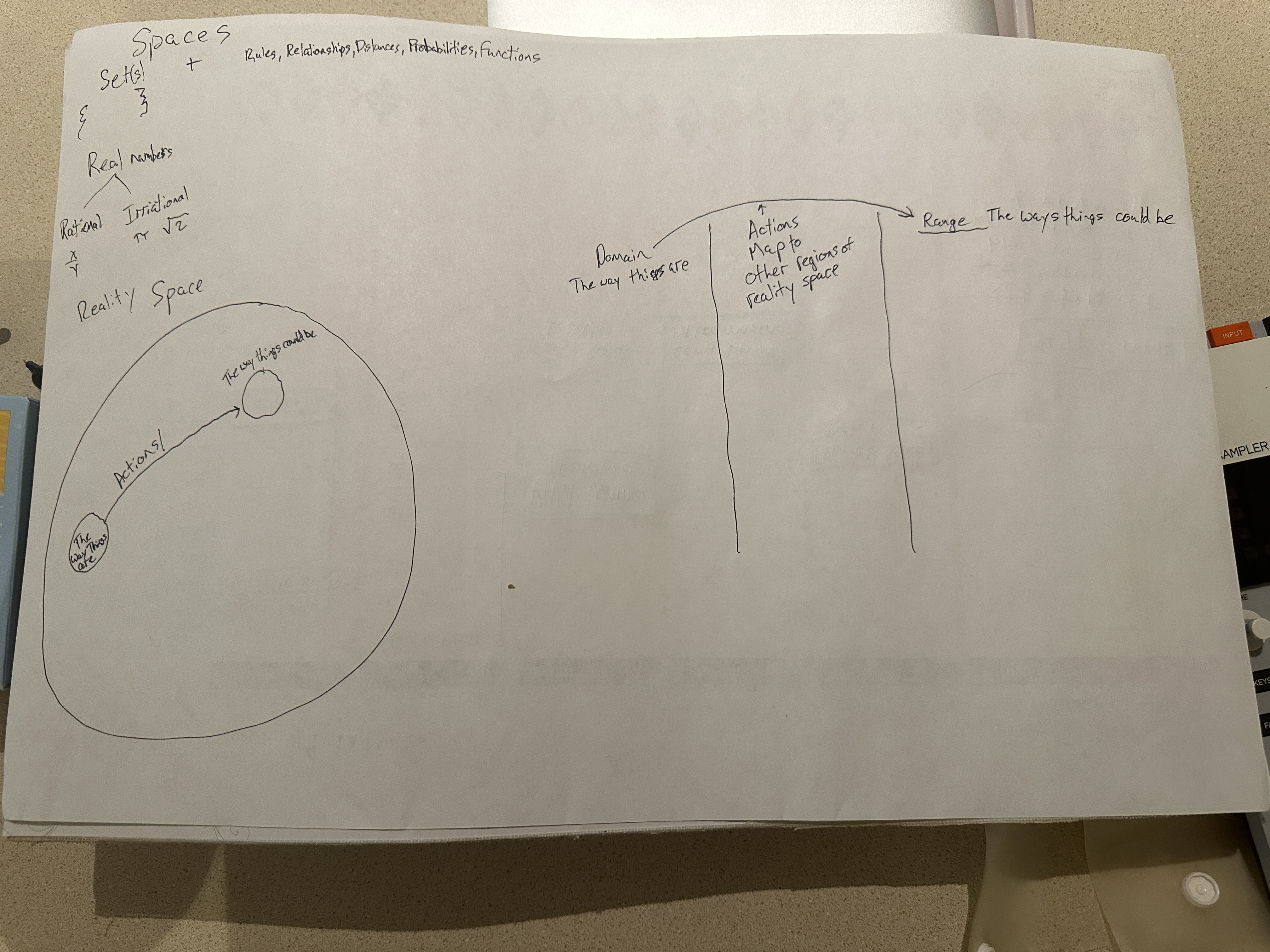
Raw Transcript
Me: I’m gonna lay out where we’re headed first so that you don’t get uh overwhelmed by the math, okay. We’re headed towards a more complete description of what I’m pointing at with my kind of rudimentary visualization that I showed yesterday, okay, that mapped emotions to actions that you could take given those emotions and kind of the results, all right? And I need to I need to bring in some more mathematical concepts in order to describe really what I’m talking about here, okay. So in mathematics, there’s this idea of a space, okay? And a space is a it’s a set and some thing that like governs the uh governs the elements of the set, okay. So a set is just you know, literally a set of elements, okay. So you have you know what’s a given set? There’s like the set of real numbers, okay? The set of real numbers. Real numbers, okay. And inside of the real the set of real numbers, there’s other subsets like those that are rational and irrational. And rational just means that you can define them in terms of a ratio, okay? So a number over another number, x over y. Okay. Okay. And irrational is you cannot do that. So like what are irrational numbers? Pi, for example, right? The square root of two. There’s no way that you can describe that as a ratio of two numbers. Okay. So we see here that there’s like sets that have a bunch of things inside of it. Okay. And then there is kind of like rules and relationships. Right? It might be distances. It might be probabilities. There’s all of these things that when you take these two things together, they define what’s called a space. Okay. A space. Right. So, like, for example, with real numbers, there’s a thing called metric space. Okay. That is the set of real numbers and a notion of distance between the elements of the set. Okay. Measured by a distance function. So there’s like, you know, functions. Functions? Yes. Okay. Functions and stuff. And this forms a space. Okay. Now what I’m pointing at, okay, in my kind of theory. Is that I’m trying to define a space. Okay. In terms of like there is reality. Okay. It’s like a reality space. Okay. Within you know, within reality space, there are sets. Okay. For example, a set might be the way things are. Okay. The way things are. And it’s just a set of like attributes of the way things are. Okay. And then in some other region of reality space, there’s there might be a set of like all of the ways that things could be. Okay.
My Wife: So possibilities.
Me: The way things could be. And that’s a set of sets. Okay. So this is just one set, the way that things are. But the way that things could be are a set of sets, right? Of different ways things could be. Okay. So within that set, there is one way that things could be. There’s another way that things could be. Okay. And it’s not that given a way that things are, that it could be any way, right? It’s restricted based on the way that things are. It’s path-dependent trajectory, kind of, right? Within a given state of things within reality space, you can only get to certain ways that things could possibly be. Okay. States like that, right? So reality set reality space is made up of states with attributes. Okay. And the kind of rules that govern it, there’s certain probabilities, there’s certain functions or actions that you could take, okay, with certain probabilities of outcomes. So the map between the way that things are, and one of the ways that things could be, right? There’s particular actions with you know, given probabilities of outcomes that map you from the way that things are to the way that things could be. Okay. And so you know, right here, when we define these actions, these functions, I kind of think about it as you have the domain, okay, which is the way things are okay. There’s the range, right? Which is the ways things could be. And then there are actions. Okay. Okay. Those actions have certain likelihoods of leading to a particular way that things could be. Okay. Okay. And so this is kind of how I’m thinking about it, right? And I think that what happens is with people is oftentimes they get stuck in the way that things are. Okay. Okay. Or they get stuck not being able to imagine another way that things could be. They either hyperfocus on the way that things are, or they lack, even if they aren’t hyper-focused on the way that things are, they lack the imaginative capacity to imagine a new way that things could be.
My Wife: So for for for these one, yeah, you need people to be creative and think outside the box.
Me: For sure. It requires that they think outside the box. This whole thing requires that they think outside the box. Okay. Okay. And then another failure state is even if they can imagine the way that things could be, they either can’t imagine what actions would get them there, or they misassign the likelihood that a particular action will get them there. Okay. Right. Okay. They they for example, right? Somebody’s fat. And they aren’t hyper focused on the way that they’re fat, and they haven’t resigned themselves to that fact. They can imagine being skinny. Okay. Yeah. They can imagine it. But because of lack of information or something like that, right? They’re unable to think of the actions that would lead them to being skinny. Right. And also, all of these actions haven’t been fully explored by everyone. And it and the probabilities might be unique to them based on their circumstances and based on the way that things are. Yeah. Right. And so really to move from one area, one region of reality space to another, right? A lot of things have to align. Okay. In order to do this intentionally. Right? And to actually get into the region that you’re looking to get into. Right? Yeah. Um it requires, like you said, creativity, imagination, open-mindedness. It requires research, right? It requires experimentation. Yeah. In doing that, right? And so, you know, humans throughout history have come up with all manner of ways of kind of navigating through reality space. Right. You have you have science, you have uh like storytelling and myth was you know one of the technologies that they used to move from one area of reality space to another or to preserve their situation in a given air uh region of reality space, right? Okay, and then you have magic, you have all sorts of things, right?
My Wife: For you in your personal like examples for life, have you been able to demonstrate that this works or is a new framing for you?
Me: A new craving? What does that mean? No.
My Wife: In your life, can you give me examples of places where you’ve been able to do these?
Me: Yeah, absolutely.
My Wife: Like storytelling, like can you tell me one? I mean that it’s been super powerful and predominant.
Me: For sure. There was uh a particular set of attributes that were the way that things were after my mom’s cancer treatment, for example. Okay, there was anxiety, so on and so forth, right? And there were actions that I took that led to uh undesirable uh new ways that things were. Okay, and there were actions I took that led to more desirable ways that things were. Okay, okay. So, an example of an action I took that led to a less desirable uh region within reality space was I started smoking a lot of weed and I got addicted to drugs. Okay. Yeah. Okay. And when I looked at it, right? There was something going on where I looked at it, for some reason I thought to myself, the anxiety that like the region of reality space that is characterized or has the attributes of anxiety and things of that nature are actually in that given state of mind. I was assessing them as being less desirable than the set of attributes for the reality space where I was a drug addict. And I was constantly catatonic from smoking marijuana. Right. Okay. And I was kind of stuck in that region. It was it was pretty tough to get out of it, right? And it took certain actions, certain, you know, uh things to lead me away from that less desirable region of reality space. Okay. Okay. And into a new one. And one of those things was, for example, meditation. Yeah. There was psychedelics. What did the psychedelics do? Both of them. Both the meditation and the psychedelics.
My Wife: That was like the domain.
Me: No. Okay. The domain is the way that things were. So the way that things were was anxious, depression. Anxious depression when not on drugs, and catatonic when on drugs, and also addicted to drugs and so on and so forth, right? Okay. The actions were meditation, psychedelics, things of that nature. And why did those things seem to lead to a more desirable region of reality space? The reason why is because of the things that you said before. It required creative thinking, thinking outside of the box, right? Yeah. Looking at things in a different way. Guess what meditation and psychedelics do? Do that. They do that. Now, this also is a very good framework for thinking about why it’s not always good to do those things. Why? Because when you’re in a particularly desirable region of reality space, right, and you start introducing things that make you look at it from a different perspective, that might not necessarily lead you to another more desirable region of reality space. It might take you to a less desirable one. Yeah. Right. There’s always that chance, always that possibility, right? And so really you employ this when you need to get out of a particularly bad region of reality space, or you need to come to an appreciation that the region of reality space that you’re currently in, right? Or that currently exists is not actually as bad as you think it is. Yeah. Okay. Because you see how it could be worse. All of those things, right? And so, you know, I personally like this framework a lot because it says, you know, put the cards on the table, describe what is. Yeah. With as best, you know, in as best a way as you possibly can, being honest, you know, it requires some reflection on the way that things are. Okay. Okay. And then it lay it opens you up to the possibility that things could be different than how they are, right? And it it talks about literally the way that you move between regions of reality space. Yeah. Okay. And so, you know, we can get more detailed by talking about, you know, what within a given region of reality space, what are the defining attributes of that region, right? Specific emotions, circumstances, ideas, ways of thinking, perspectives, uh, frames, so on and so forth, right? Even there are particular actions that are associated with a given region of reality space that that point that map back into itself. Does that make sense? Yeah. It’s like there are particular actions that lead you back into that space and keep you in that space. Keep the set of attributes the same, right? Because of entropy, if you just did nothing, probably things would change, right? It’s relying a specific region of reality space, is dependent on certain actions to keep it, keep the integrity of that region. Yeah. Right? Okay. If you just do nothing, honestly, sometimes that’s a thing, like if you just stop doing the things, yeah. If you just stop doing the things that are reinforcing the the set of of attributes that define a given region of reality space, uh, then it might fall apart and it might stop being like that. Yeah, okay. Sometimes that’s an option, it is so you know I this framework to me is really like it’s uh kind of like the result of all these things coming together. My study of mathematics, yeah, and the various you know things that I’ve done from a self-development perspective that have led me to kind of have this as like a grand theory of the way that things are, yeah, right, and the way that we can a framework, a philosophy, a philosophy. Well, the how do I say this is less of a philosophy and more of a framework, a lens that if we view the world through this, a lot of things fall into place that you know make it easier to think about uh how we can move through the world, yeah, right?
My Wife: Yeah, cool.
Me: You think about the ways that people get stuck, right? Yeah, one of the ways that people get stuck is there’s a given set of the way that things are, yeah. They’re in a given region of reality space. There’s reinforcing functions that are keeping them, keeping those things the way that they are, right? And they part of the ask attributes of that reality space is that there’s given views about actions and their probabilities of making a change. Okay, it’s like a hopelessness. The suggestions that people make about the actions, right? At any given point in time, they you know aren’t able to employ it because they don’t believe that it’s actually going to affect the change that they you know think would be desirable, right? They’re extreme extremely skeptical. And that skepticism is one of the forcing functions that keep maps back into their current reality space, right? And so it risk requires the suspension of skepticism, it requires a step forward with faith or in faith, a leap into faith, right? In order for them to ever break out of that region, yeah, right? If you keep doing the same things, right, there’s a high probability, not a not a guarantee, and not you know, not a guarantee, but a high probability that you will stay within the same region of reality space. Yeah.
My Wife: So you need to try to do like different things.
Me: Right? It would be sit down and describe the way that things are. What do you think? What do you feel? That’s the first step. That’s the first step. What do you think? What do you feel? What do you do? Yeah. Okay. What is your relationship to what you think, feel, and do, right? How do you see the world? What frames are you seeing the world through? Okay. You describe all of those things, right? Then you sit down, right? And you might use imaginary aids or something, right? Or you might just enter into meditation, or you might just wing it, right? But you sit down and you start to imagine new ways that it could be. Yeah. Okay. How could it be different, right? And sometimes all you need to do is just sit down and write the opposite of that, right? Like, I am unhappy right now with this, this, this, this, this, right? And how could things be? I could be happy with those things. And it’s not a statement that you believe that there is an action that would lead to it. It that’s not what it is. It’s a hypothetical. It could be the that way, right? Okay. There is a world that I am capable of imagining where this is the case. Right. Right. And if they find themselves saying, I can’t imagine it because I’m so stuck in this current reality, then you stick with that exercise until you can imagine it, right? You imagine a version of you that is happy, that is not addicted to drugs, that is skinny, that is blah blah blah, right? Okay. Then you go and you list out a brainstorm of different actions, right? Actions that are different than the current actions that you’re taking that are reinforcing the way that things are, right? Okay. And you think about the likelihood that it would move you outside of that given region of reality space. And it’s not that necessarily you’re looking for actions that get you to a desirable region of reality space. Okay. But okay. It’s not necessarily that. It’s will this action give me good information about the sensitivity of the given region that I’m in and how it responds to different actions, right? Like, is it a robust and you know, is it a robust region of reality space that is not super affected by given actions, right? Or is it a very fragile one? I change something a tiny bit, and all of a sudden the whole thing changes, right? So you’re doing experimentation and information gathering, right? And honestly, you’re kind of winging it a little bit, right? You can think like in terms of the wisdom of the ancients and so on and so forth, you know, what have people said actually leads to more desirable regions of the reality space, but but in actuality, what you’re doing is you’re trying to get hard-earned wisdom, okay? You’re pursuing different actions in order to learn things about reality space, right? Because if you’ve remained stuck in a given place, it can become totalizing. You can think that this is all there is, right? But that’s foolishness. We know that that’s foolishness. There’s so many different ways that things could be, and it’s in infinite. Theoretically, possibly it might be infinite ways that things could possibly be, but I don’t know. I think that physics would kind of disagree with that. I don’t, I’m not smart enough to know that. But who knows? Yeah. Okay. It comes from imagining new ways that things could be, right? And experiencing the effects of taking new courses of action. And seeing how that affects your life and the world around you.
My Wife: So the theory you’re proposing, or like the framework, it’s based on a lot of experimentation and analysis.
Me: Yeah, I mean, I’ve I’ve I’ve navigated through reality space by taking different courses of action, ones that a lot of people have never, not that a lot of people have never taken, but ones that most people will never take. Yeah. Right. Moving abroad, living in different places, learning new languages, learning new things, working in different capacities, taking drugs, you know, doing meditation, like investigating religions, living out religions, right? Doing the practice, actually. Yeah. So on and so forth. Different diets, different exercises, right? Different sports, dating different people, being with different friends, reading different things, do all of those courses of action. So variety. Variety, yeah. And it’s not that variety, it wasn’t variety for variety’s sake, right? Like I kind of, you know, this is where we come into ideas of, you know, is God guiding us? Yeah. Or karma, for example. Okay, let’s talk about it from a karmic perspective. Right. Karma says basically that from this framework, if we’re gonna analyze this from a karmic perspective, yeah, right, it’s that as you’ve occupied a particular region of reality space, right? And you’ve practiced the actions that reinforce that reality space, right? It becomes easier and easier and more likely the probability of remaining in that reality space increases, basically, right? Okay, and it’s only through actions that differ that you can come to experience a different like way of being, a different reality. Yeah, right. That’s karma. Okay, the things that you do either reinforce or lead away from particular circumstances, right? Like one example that the Buddha gives is whatever we frequently think and dwell upon becomes the inclination of the mind, right? If you continuously think and dwell upon things that reinforce a given your your uh given reality space, yeah, your given region of reality space, then it becomes more and more likely that you will remain in that region. Exactly, right? If you incline the mind towards thinking about different ways that things could be and different actions, right? Then it’s unlikely that you’re going to remain very long in the same exact set of circumstances. Right. Now, from the perspective of God and things of that nature, you know, like, was there anything that was kind of guiding me through my navigation of reality space? Yeah. Right. I mean, from my perspective personally, I kind of think of the entirety of this reality space as God. Right? That we are kind of, you know, living in constant relationship with God. Right? Yeah. We are always in this reality space where there are all of these things that are, you know, like have these different likelihoods of being, right? Different ways of being. Yeah. And all of that to me, the total, the all, is God. Yeah. Right? And so to be in good relationship with God is to love reality space. Okay. And to be in bad relationship with God is to hate it. Right? And to resent it. And to turn away from it and to deny it. Right. Like, if we acknowledge this is the way that things are, that there are different possibilities of the way that things could be, and that there are actions, right? And that I have a responsibility to do certain actions to explore, to become wise, that that is loving God. Yeah. Right. And to say, this is the only way that things could ever be, and I hate it, and I’m not even going to try. Right? Nihilism is to hate God. Yeah. To turn away from God. To deny God. Right? To say that like it things could only ever be bad is to hate God. And to deny reality space. The fact that there are ever even possibilities that could possibly be good. Right? And that in and of itself is a region of reality space that is particularly bleak and particularly hard to break out of. Yeah. Right? It’s very heavily self reinforcing. Right. So those are kind of my thoughts. Okay. Any questions?
My Wife: Super clear.
Me: Super clear. Yeah. Exactly 30 minutes. Beauty.
Comments
Loading comments...